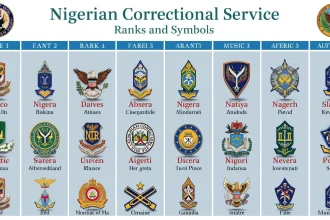


These complete guide contains the list of Police Ranks and symbols in Nigeria, with Insignia shows the complete ranking structure of the Nigeria Police Force from lowest to highest. Inspector General of Police tops this list as the highest rank in the Nigeria Police Force. This makes understanding the rank hierarchy essential for anyone interested in Nigerian law enforcement, policing careers, or joining the Nigeria Police Force.
The Nigeria Police Force (NPF) is the principal law enforcement agency in Nigeria with over 370,000 personnel nationwide. The force operates a hierarchical ranking system with clear symbols and insignia for each rank. These ranks are divided into senior police officers, junior police officers, and constabulary ranks with specific responsibilities, salaries, and promotion pathways.
Quick Summary: List of Police Ranks And Symbols in Nigeria 2026
Senior Police Officers (9 Ranks):
- Inspector General of Police (IGP) – Four silver stars (Force Commander)
- Deputy Inspector General of Police (DIG) – Three silver stars
- Assistant Inspector General of Police (AIG) – Two silver stars with eagle
- Commissioner of Police (CP) – One silver star with eagle
- Deputy Commissioner of Police (DCP) – Crown and one silver star
- Assistant Commissioner of Police (ACP) – Crown with ribbon
- Chief Superintendent of Police (CSP) – Three silver stars horizontal
- Superintendent of Police (SP) – Two silver stars horizontal
- Deputy Superintendent of Police (DSP) – One silver star
Junior Police Officers (3 Ranks):
- Assistant Superintendent of Police (ASP) – One silver bar
- Assistant Superintendent of Police II (ASP II) – One silver bar (entry)
- Inspector of Police – Three chevrons down, one up
Constabulary Ranks (6 Ranks):
- Sergeant Major – Crown above three chevrons
- Sergeant – Three chevrons pointing down
- Corporal – Two chevrons pointing down
- Lance Corporal – One chevron pointing down
- Police Constable (PC) – No insignia
- Recruit Constable – Training rank
How We Organized Nigerian Police Ranks
Our comprehensive guide looks at many factors. These include rank insignia descriptions, salary scales, promotion requirements, command responsibilities, and official Nigeria Police Force documentation. We used criteria like Police Service Commission regulations, Force Orders, verified salary information, and authoritative sources to present the complete ranking structure.
Police Ranks And Symbols in Nigeria 2026
1. Inspector General of Police (IGP) – Four Silver Stars
Inspector General of Police is the highest rank in the Nigeria Police Force with a four silver star insignia. The IGP commands the entire Nigeria Police Force with responsibility for over 370,000 personnel and law enforcement across all 36 states plus FCT.
Key Details:
- Insignia: Four silver stars in diamond formation with eagle
- Symbol: Nigerian coat of arms with four stars
- Position: Force Commander, Principal Security Officer
- Salary: ₦1.5-₦2 million monthly (plus allowances)
- Requirements: Distinguished service, minimum 30+ years
Responsibilities:
- Commands entire Nigeria Police Force
- Principal police advisor to President
- Sets police policy and strategy nationwide
- Oversees all police formations and commands
- Manages police budget (₦500+ billion annually)
- Represents Nigeria Police internationally
Appointment Process:
- Presidential nomination
- Senate confirmation required
- Selected from serving DIGs or AIGs
- Typically 32-35 years of service
- Serves at President’s pleasure
Current Holder:
- IGP Kayode Adeolu Egbetokun (2023-present)
- Previous: IGP Usman Alkali Baba (2021-2023)
- Appointed by President as Commander-in-Chief
- Headquarters at Force Headquarters, Abuja
- Typically 2-4 year tenure
2026 Highlights: The IGP commands Nigeria’s largest law enforcement agency with 370,000+ personnel across 1,154 police formations nationwide. The IGP oversees operations against crime, terrorism, kidnapping, and other security challenges with an annual budget exceeding ₦500 billion.
2. Deputy Inspector General of Police (DIG) – Three Silver Stars
Deputy Inspector General of Police is a three-star rank typically held by zonal commanders and Force Headquarters department heads. DIGs represent the highest operational commanders in the Nigeria Police Force.
Key Details:
- Insignia: Three silver stars in triangle formation with eagle
- Symbol: Coat of arms with three stars
- Position: Zonal Commanders, Force HQ departments
- Salary: ₦1.2-₦1.5 million monthly
- Requirements: Serve as AIG, 28+ years service
Typical Positions:
- Zonal Police Commanders (17 zones nationwide)
- Deputy Force Secretary
- Force Public Relations Officer (senior)
- Department heads at Force Headquarters
- Special operations commanders
Command Responsibility:
- Commands 15,000-30,000 officers
- Oversees multiple state commands
- Strategic planning and operations
- Policy implementation
- Reports to Inspector General
Promotion Requirements:
- Minimum 4-6 years as AIG
- Outstanding command performance
- Strategic leadership capability
- Police Service Commission recommendation
- Presidential approval
2026 Highlights: DIGs command Nigeria’s 17 police zones including Zone 2 (Lagos), Zone 7 (Abuja), Zone 13 (Calabar), and others. They oversee multiple state police commands and coordinate major operations. Approximately 10-15 DIGs serve actively in the Nigeria Police Force.
3. Assistant Inspector General of Police (AIG) – Two Silver Stars
Assistant Inspector General of Police is a two-star rank held by state command commissioners in large states, zonal operations commanders, and senior Force HQ officers.
Key Details:
- Insignia: Two silver stars with eagle above
- Symbol: Eagle with two stars
- Position: State Commissioners, zonal operations
- Salary: ₦900,000-₦1.2 million monthly
- Requirements: Serve as CP, 24+ years service
Typical Positions:
- State Commissioners of Police (Lagos, Kano, Rivers)
- Zonal operations commanders
- Special operations heads (FSARS, CTU, IRT)
- Force training institutions commandants
- Senior Force HQ department directors
Command Responsibility:
- Commands 8,000-15,000 officers
- Oversees state-wide operations
- Crime prevention and control
- Resource allocation
- Training and development
Promotion Requirements:
- Minimum 3-5 years as CP
- Successful command performance
- Professional development courses
- Police Service Commission approval
- Presidential endorsement
2026 Highlights: AIGs command critical state police commands including Lagos (largest), Kano, Rivers, Kaduna, and FCT. They lead operations against kidnapping, terrorism, armed robbery, and other major crimes. Approximately 25-35 AIGs serve in the Nigeria Police Force.
4. Commissioner of Police (CP) – One Silver Star
Commissioner of Police is a one-star rank commanding state police commands or heading major departments at Force Headquarters. CPs are senior operational commanders with 20-24 years of service.
Key Details:
- Insignia: One silver star with eagle above
- Symbol: Eagle with single star
- Position: State Police Commissioners, department heads
- Salary: ₦700,000-₦900,000 monthly
- Requirements: Serve as DCP, 20+ years service
Typical Positions:
- State Commissioners of Police (36 states)
- FCT Police Commissioner
- Department heads at Force HQ
- Special operations commanders
- Training institution commandants
Command Responsibility:
- Commands 3,000-8,000 officers per state
- Oversees all police divisions in state
- Crime control and prevention
- Public order management
- Reports to Zonal Commander (DIG)
Promotion Requirements:
- Minimum 3-4 years as DCP
- Successful state command
- Professional courses completed
- Police Service Commission approval
- Clear service record
2026 Highlights: Commissioners of Police command all 36 state police commands plus FCT, managing daily law enforcement operations, crime investigation, and public safety. They coordinate with state governors and security agencies. Approximately 50-70 CPs serve nationwide.
5. Deputy Commissioner of Police (DCP) – Crown and One Star
Deputy Commissioner of Police is a senior rank serving as deputy state commissioners, area commanders in major cities, or senior departmental officers.
Key Details:
- Insignia: Crown above one silver star
- Symbol: Crown with star
- Position: Deputy state commissioners, area commanders
- Salary: ₦500,000-₦700,000 monthly
- Requirements: Serve as ACP, 18+ years service
Typical Positions:
- Deputy State Commissioners
- Area Commanders (Lagos Island, Ikeja, Surulere, etc.)
- SCID commanders (State CID)
- Senior Force HQ officers
- Special squad commanders
Command Responsibility:
- Commands 1,500-3,000 officers
- Oversees multiple divisions
- Operations coordination
- Investigation supervision
- Training oversight
Promotion Requirements:
- Minimum 3-4 years as ACP
- Successful area command
- Professional development
- PSC promotion board approval
- Consistent performance ratings
2026 Highlights: DCPs command police areas in major cities and serve as deputy commissioners in state commands. They coordinate tactical operations and manage divisional commanders. Approximately 150-200 DCPs serve across Nigeria.
6. Assistant Commissioner of Police (ACP) – Crown With Ribbon
Assistant Commissioner of Police is a mid-senior rank commanding police divisions, heading units, or serving as staff officers at state and Force HQ.
Key Details:
- Insignia: Crown with ribbon below
- Symbol: Crowned ribbon
- Position: Divisional Police Officers (DPOs), unit commanders
- Salary: ₦400,000-₦500,000 monthly
- Requirements: Serve as CSP, 16+ years service
Typical Positions:
- Divisional Police Officers (major divisions)
- Unit commanders (Traffic, CID, SARS)
- State command department heads
- Force HQ staff officers
- Training school instructors
Command Responsibility:
- Commands 500-1,500 officers
- Oversees divisional operations
- Crime investigation and prevention
- Public order maintenance
- Community policing
Promotion Requirements:
- Minimum 3-4 years as CSP
- Successful divisional command
- Professional courses
- Promotion board approval
- Strong performance record
2026 Highlights: ACPs serve as DPOs in major police divisions across Nigeria commanding hundreds of officers. They manage daily operations, investigations, and community relations. Many ACPs lead specialized units like SCID, Traffic, and tactical squads.
7. Chief Superintendent of Police (CSP) – Three Silver Stars
Chief Superintendent of Police is a senior officer rank serving as DPOs in medium divisions, unit seconds-in-command, or senior staff officers.
Key Details:
- Insignia: Three silver stars horizontal with ribbon
- Symbol: Three stars (★★★)
- Position: DPOs, deputy unit commanders
- Salary: ₦300,000-₦400,000 monthly
- Requirements: Serve as SP, 14+ years service
Typical Positions:
- Divisional Police Officers (medium divisions)
- Deputy area commanders
- Unit deputy commanders
- State command staff officers
- Investigation unit heads
Command Responsibility:
- Commands 200-500 officers
- Divisional operations management
- Investigation oversight
- Personnel administration
- Community engagement
Promotion Requirements:
- Minimum 3-4 years as SP
- Successful command tour
- Professional development courses
- Promotion board selection
- Clear discipline record
2026 Highlights: CSPs command police divisions in urban and semi-urban areas managing daily policing operations. They lead investigation units and tactical teams. Approximately 500-800 CSPs serve across the Nigeria Police Force.
8. Superintendent of Police (SP) – Two Silver Stars
Superintendent of Police is a mid-level senior officer serving as DPOs in smaller divisions, unit officers, or staff officers at area and state commands.
Key Details:
- Insignia: Two silver stars horizontal with ribbon
- Symbol: Two stars (★★)
- Position: DPOs, unit officers, staff officers
- Salary: ₦250,000-₦300,000 monthly
- Requirements: Serve as DSP, 12+ years service
Typical Positions:
- Divisional Police Officers (small divisions)
- Unit officers (Traffic, CID sections)
- Area command staff officers
- Investigation officers
- Operations coordinators
Command Responsibility:
- Commands 100-300 officers
- Divisional operations
- Investigation coordination
- Personnel management
- Community relations
Promotion Requirements:
- Minimum 3-4 years as DSP
- Successful operational performance
- Professional courses completed
- Promotion board approval
- Good service record
2026 Highlights: SPs command numerous police divisions across Nigeria, especially in suburban and rural areas. They manage frontline operations and investigations. Many SPs lead specialized sections within larger divisions.
9. Deputy Superintendent of Police (DSP) – One Silver Star
Deputy Superintendent of Police is the entry-level senior officer rank serving as deputy DPOs, unit officers, or section heads with 10-12 years of service.
Key Details:
- Insignia: One silver star horizontal with ribbon
- Symbol: One star (★)
- Position: Deputy DPOs, unit officers, section heads
- Salary: ₦200,000-₦250,000 monthly
- Requirements: Serve as ASP, 10+ years service
Typical Positions:
- Deputy Divisional Police Officers
- Unit officers (Traffic, CID)
- Section heads at divisions
- Investigation officers
- Operations officers
Command Responsibility:
- Second-in-command at divisions
- Supervises 50-150 officers
- Investigation management
- Operational coordination
- Reports to DPO
Promotion Requirements:
- Minimum 3-4 years as ASP
- Successful operational performance
- Professional courses
- Promotion board approval
- Clear service record
2026 Highlights: DSPs serve as deputy DPOs in police divisions and command smaller stations. They bridge senior and junior officer ranks, managing daily operations and supervising investigations. Approximately 2,000-3,000 DSPs serve nationwide.
Junior Police Officer Ranks (Detailed)
1. Assistant Superintendent of Police (ASP) – One Silver Bar
Assistant Superintendent of Police is the first officer rank for university graduate recruits and promoted Inspectors. ASPs serve as section officers, investigation officers, or unit assistants.
Key Details:
- Insignia: One silver bar horizontal
- Symbol: Single bar (—)
- Position: Section officers, investigation officers
- Salary: ₦150,000-₦200,000 monthly
- Requirements: University degree or promotion from Inspector
Typical Positions:
- Section officers at divisions
- Investigation officers
- Unit assistants
- Station officers (small stations)
- Administrative officers
Command Responsibility:
- Commands 20-50 officers
- Section operations management
- Investigation coordination
- Administrative duties
- Reports to senior officers
Entry Routes:
- University graduate recruitment
- Nigeria Police Academy (4-year degree)
- Promotion from Inspector rank
- Special entry programs
- Professional recruitment
Promotion Requirements:
- Minimum 3-4 years in rank
- Successful operational performance
- Professional development courses
- Promotion examination
- Supervisory experience
2026 Highlights: ASPs are junior officers learning command and investigation skills. University graduates enter at ASP II and promote to ASP after 2-3 years. Many ASPs serve as investigation officers at SCID and divisional CID.
2. Assistant Superintendent of Police II (ASP II) – One Silver Bar
ASP II is the entry rank for newly graduated university recruits from Nigeria Police Academy or general graduate recruitment programs.
Key Details:
- Insignia: One silver bar (same as ASP)
- Symbol: Single bar (—)
- Position: Junior section officers, trainee officers
- Salary: ₦120,000-₦150,000 monthly (plus allowances)
- Requirements: University degree, Police Academy graduation
Typical Positions:
- Junior section officers
- Assistant investigation officers
- Unit trainee officers
- Station assistants
- Administrative support
Command Responsibility:
- Supervises 10-30 officers
- Learning command responsibilities
- Investigation assistance
- Operational support
- Professional development
Entry Requirements:
- University degree (minimum 2nd class lower)
- Age 18-25 years
- Pass screening and interview
- Complete cadet training
- Meet physical standards
2026 Highlights: ASP II officers are newly commissioned officers undergoing on-the-job training. They learn investigation, operations, and command skills. Most promote to ASP after 2-3 years of satisfactory service.
3. Inspector of Police – Three Chevrons Down, One Up
Inspector of Police is the highest non-commissioned rank or junior officer rank serving as station officers, investigation officers, or unit supervisors.
Key Details:
- Insignia: Three chevrons pointing down, one pointing up
- Symbol: ∨∨∨∧
- Position: Station officers, unit supervisors
- Salary: ₦100,000-₦130,000 monthly
- Requirements: Promotion from Sergeant Major or direct entry
Typical Positions:
- Station officers (small stations)
- Investigation officers
- Unit supervisors (Traffic, CID)
- Patrol leaders
- Administrative officers
Command Responsibility:
- Commands 15-40 officers
- Station operations management
- Investigation supervision
- Patrol coordination
- Reports to ASP or senior officers
Promotion Requirements:
- Minimum 4-6 years as Sergeant Major
- Promotional examination passed
- Good service record
- Supervisory experience
- Professional courses
2026 Highlights: Inspectors manage small police stations and lead investigation teams. They bridge junior officers and constabulary ranks. Many Inspectors are promoted to ASP after 6-8 years of distinguished service.
Constabulary Ranks (Detailed)
1. Sergeant Major – Crown Above Three Chevrons
Sergeant Major is the highest constabulary rank in the Nigeria Police Force serving as senior station NCOs, unit sergeants major, or senior technical specialists.
Key Details:
- Insignia: Crown above three chevrons pointing down
- Symbol: Crown + ∨∨∨
- Position: Station sergeant major, unit sergeant major
- Salary: ₦80,000-₦100,000 monthly
- Requirements: Serve as Sergeant, 12+ years service
Typical Positions:
- Station sergeant major
- Unit sergeant major
- Senior technical specialists
- Training instructors
- Administrative NCOs
Responsibilities:
- Senior NCO at stations
- Discipline and standards enforcement
- Personnel administration
- Training supervision
- Equipment management
Promotion Requirements:
- Minimum 4-6 years as Sergeant
- Excellent service record
- Leadership capabilities
- Technical expertise
- Promotion examination
2026 Highlights: Sergeant Majors serve as senior NCOs in police divisions and units managing constabulary personnel. They ensure discipline, standards, and operational readiness across units.
2. Sergeant – Three Chevrons Down
Sergeant is a senior constabulary rank serving as patrol leaders, investigation assistants, or section supervisors with 8-12 years of service.
Key Details:
- Insignia: Three chevrons pointing down
- Symbol: ∨∨∨
- Position: Patrol leaders, section supervisors
- Salary: ₦70,000-₦85,000 monthly
- Requirements: Serve as Corporal, 8+ years service
Typical Positions:
- Patrol leaders (6-12 officers)
- Investigation assistants
- Section supervisors
- Station desk officers
- Technical specialists
Responsibilities:
- Commands patrol teams
- Investigation support
- Personnel supervision
- Report writing
- Community policing
Promotion Requirements:
- Minimum 3-4 years as Corporal
- Leadership demonstration
- Professional courses
- Promotion examination
- Clear discipline record
2026 Highlights: Sergeants lead patrol teams and investigation units at divisional level. They provide tactical leadership and supervision to junior constables. Approximately 15,000-25,000 Sergeants serve in the NPF.
3. Corporal – Two Chevrons Down
Corporal is a mid-level constabulary rank serving as team leaders, checkpoint supervisors, or technical specialists with 5-8 years of service.
Key Details:
- Insignia: Two chevrons pointing down
- Symbol: ∨∨
- Position: Team leaders, checkpoint supervisors
- Salary: ₦60,000-₦75,000 monthly
- Requirements: Serve as Lance Corporal, 5+ years
Typical Positions:
- Patrol team leaders (4-6 officers)
- Checkpoint supervisors
- Investigation assistants
- Station duty officers
- Technical operators
Responsibilities:
- Commands small teams
- Patrol operations
- Investigation support
- Traffic control
- Community engagement
Promotion Requirements:
- Minimum 2-3 years as Lance Corporal
- Leadership potential
- Professional courses
- Promotion examination
- Good performance
2026 Highlights: Corporals lead small teams at checkpoints, patrols, and stations. They provide frontline supervision and assist Sergeants in operations. Many Corporals serve in specialized units like Traffic, CID, and MOPOL.
4. Lance Corporal – One Chevron Down
Lance Corporal is a junior NCO rank earned by constables showing leadership potential after 3-5 years of service.
Key Details:
- Insignia: One chevron pointing down
- Symbol: ∨
- Position: Team leaders, senior constables
- Salary: ₦55,000-₦65,000 monthly
- Requirements: Serve as PC, 3+ years service
Typical Positions:
- Small team leaders (2-4 officers)
- Senior patrol constables
- Investigation assistants
- Station duty assistants
- Traffic controllers
Responsibilities:
- Leads 2-4 constables
- Patrol operations
- Investigation support
- Report writing
- Equipment maintenance
Promotion Requirements:
- Minimum 2-3 years as PC
- Leadership potential
- Professional courses
- Promotion examination
- Supervisor recommendation
2026 Highlights: Lance Corporals are experienced constables showing leadership. They assist Corporals and Sergeants while learning supervisory responsibilities. Most Lance Corporals promote to Corporal after 2-3 years.
5. Police Constable (PC) – No Insignia
Police Constable is the entry rank for all non-graduate recruits in the Nigeria Police Force. PCs complete basic training and serve as regular police officers.
Key Details:
- Insignia: No rank insignia
- Symbol: Plain uniform
- Position: Patrol officer, station constable
- Salary: ₦45,000-₦60,000 monthly (plus allowances)
- Requirements: Complete Police College training
Typical Positions:
- Patrol officers
- Station constables
- Traffic control officers
- Investigation assistants
- Guard duty officers
Responsibilities:
- Patrol operations
- Crime prevention
- Investigation assistance
- Traffic control
- Community policing
Recruitment Requirements:
- SSCE/NECO certificate minimum
- Age 18-25 years
- Height: Men 1.67m, Women 1.64m
- Pass physical and medical tests
- Clean criminal record
Training Duration:
- 6 months at Police College
- Basic policing training
- Physical fitness
- Law enforcement procedures
- Weapons training
2026 Highlights: Police Constables form the majority of Nigeria Police Force personnel. They conduct daily patrol, investigation, traffic control, and community policing. PCs can promote to Lance Corporal after 3 years of good service.
6. Recruit Constable – Training Rank
Recruit Constable is the initial training rank for new police recruits undergoing basic training at police colleges.
Key Details:
- Insignia: None (training uniform)
- Symbol: Recruit badge
- Position: Police trainee
- Salary: ₦30,000-₦40,000 training allowance
- Requirements: Pass recruitment screening
Training Program:
- 6 months basic training
- Physical fitness training
- Police procedures and law
- Weapon handling
- Drill and discipline
- Pass-out parade and graduation
Training Locations:
- Police College Ikeja, Lagos
- Police College Kaduna
- Police College Maiduguri
- Police College Calabar
- Other police training schools
2026 Highlights: Recruit Constables undergo intensive 6-month training to become Police Constables. Training includes physical fitness, law enforcement procedures, weapons training, and police discipline. Successful graduates pass out as Police Constables.
Police Salary in Nigeria 2026 (New)
Senior Police Officers:
- Inspector General of Police: ₦1.5-₦2 million monthly
- Deputy Inspector General: ₦1.2-₦1.5 million
- Assistant Inspector General: ₦900,000-₦1.2 million
- Commissioner of Police: ₦700,000-₦900,000
- Deputy Commissioner of Police: ₦500,000-₦700,000
- Assistant Commissioner of Police: ₦400,000-₦500,000
- Chief Superintendent of Police: ₦300,000-₦400,000
- Superintendent of Police: ₦250,000-₦300,000
- Deputy Superintendent of Police: ₦200,000-₦250,000
Junior Police Officers:
- Assistant Superintendent of Police: ₦150,000-₦200,000
- ASP II: ₦120,000-₦150,000
- Inspector: ₦100,000-₦130,000
Constabulary Ranks:
- Sergeant Major: ₦80,000-₦100,000
- Sergeant: ₦70,000-₦85,000
- Corporal: ₦60,000-₦75,000
- Lance Corporal: ₦55,000-₦65,000
- Police Constable: ₦45,000-₦60,000
- Recruit: ₦30,000-₦40,000 (training allowance)
Additional Allowances:
- Housing allowance
- Transport allowance
- Risk/hazard allowance
- Medical allowance
- Uniform allowance
- Duty allowance
- Overtime payment
- Special assignment allowances
Promotion Requirements and Timeline
Senior Police Officers:
- DSP to SP: 3-4 years
- SP to CSP: 3-4 years
- CSP to ACP: 3-4 years
- ACP to DCP: 3-4 years
- DCP to CP: 3-4 years (competitive)
- CP to AIG: 3-5 years (competitive)
- AIG to DIG: 4-6 years (competitive)
- DIG to IGP: Presidential appointment
Junior Police Officers:
- ASP II to ASP: 2-3 years
- ASP to DSP: 3-4 years
- Inspector to ASP: 6-8 years (with examination)
Constabulary Ranks:
- PC to Lance Corporal: 2-3 years
- Lance Corporal to Corporal: 2-3 years
- Corporal to Sergeant: 3-4 years
- Sergeant to Sergeant Major: 4-6 years
- Sergeant Major to Inspector: 6-8 years (with examination)
Promotion Factors:
- Time in rank/grade
- Performance evaluations
- Professional courses completed
- Promotional examinations
- Discipline record
- Seniority and vacancies
- Police Service Commission approval
Nigeria Police Force Command Structure
National Level:
- Force Headquarters, Abuja (IGP)
- Force Criminal Investigation Department
- Force Intelligence Bureau
- Special Tactical Squads (IRT, STS)
- Mobile Police Force (MOPOL)
Zonal Level:
- 17 Police Zones nationwide
- Commanded by DIGs
- Supervise multiple state commands
State Level:
- 36 State Police Commands plus FCT
- Commanded by Commissioners of Police
- Area Commands in major cities
- Police divisions across states
Divisional Level:
- 1,154 Police Divisions nationwide
- Commanded by DPOs (ACP to SP ranks)
- Police stations under divisions
- Frontline policing operations
Frequently Asked Questions
Inspector General of Police (IGP) is the highest rank in the Nigeria Police Force with four silver stars. The IGP commands over 370,000 personnel and all police operations nationwide. The President appoints the IGP with Senate confirmation.
A Police Constable earns ₦45,000-₦60,000 monthly basic salary plus allowances including housing, transport, risk, and duty allowances. Total package ranges from ₦70,000-₦95,000 monthly depending on posting and allowances.
It takes approximately 20-24 years of service to become a Commissioner of Police. Officers must progress through ASP II, ASP, DSP, SP, CSP, ACP, and DCP ranks through promotions every 3-4 years, demonstrating excellent performance and leadership.
Join as an officer through: (1) Nigeria Police Academy – 4-year degree program for SSCE holders, (2) Graduate recruitment – for university graduates entering as ASP II, (3) Promotion from Inspector rank after passing promotional examinations. Check NPF recruitment portal for openings.
ASP is a commissioned officer rank (graduate entry) while Inspector is a non-commissioned rank (promoted from constabulary). ASPs typically command larger units and have faster promotion pathways. Inspectors can become ASPs through promotional examinations.
Nigeria Police training duration varies: Constable recruits train for 6 months at Police Colleges. Police Academy cadets train for 4 years (degree + policing). Graduate recruits (ASP II) train for 6-9 months at Police Academy. Training includes physical fitness, law, procedures, and weapons.
Yes, but extremely rare. A constable would need to promote through all ranks over 30+ years, demonstrate exceptional performance, pass promotional examinations to become an officer, and continue advancement to senior ranks. Most IGPs enter as graduates.
Stars indicate officer ranks in Nigeria Police Force. One star = DSP/CP, two stars = SP/AIG, three stars = CSP/DIG, four stars = IGP. Stars appear on epaulettes (shoulder insignia). Constabulary ranks use chevrons pointing downward.
Junior ranks (PC to Inspector): Promotions every 2-4 years based on time and performance. Officer ranks (ASP to ACP): Every 3-4 years. Senior ranks (DCP to IGP): Highly competitive, 3-6 years between ranks, based on performance, vacancies, and PSC approval.
Retirement age varies: Constabulary ranks retire at 60 years or 35 years of service (whichever comes first). Officers from Inspector to AIG retire at 60 years or 35 years of service. IGP serves at President’s pleasure with no fixed tenure.
Conclusion: Understanding Nigeria Police Force Hierarchy
The list Police Ranks And Symbols in Nigeria2026: Complete Guide With Insignia provides comprehensive information about Nigeria’s law enforcement ranking structure from Police Constable to Inspector General. Understanding these ranks, insignia, and hierarchy is essential for anyone interested in Nigerian policing careers, law enforcement matters, or national security.
The Nigeria Police Force operates a professional ranking system with clear promotion pathways, competitive selection at senior levels, and strict standards for advancement. From the 370,000+ officers forming the force’s backbone to the handful of DIGs and IGP leading strategic operations, each rank plays a vital role in law enforcement and national security.
Whether you’re considering joining the Nigeria Police Force, researching law enforcement structure, or simply interested in policing matters, this complete guide provides the foundation for understanding how Nigeria’s primary law enforcement agency organizes its personnel. The combination of British colonial police tradition with Nigerian adaptations has created a professional force structure capable of meeting modern policing challenges.
From the Police Constable earning ₦45,000 monthly to the Inspector General commanding ₦2 million monthly, the Nigeria Police Force offers career progression, professional development, and service to the nation. The ranking structure ensures clear command authority, professional standards, and operational effectiveness across all 1,154 police formations nationwide.
The Nigeria Police Force continues to evolve with ongoing reforms, improved training, better equipment, and enhanced professionalism across all ranks. Understanding the ranking structure helps citizens appreciate the hierarchical organization that maintains law and order across Africa’s most populous nation.
What rank interests you most? Are you considering a Nigeria Police career? Share your questions and thoughts about Nigerian police ranks in the comments below!